
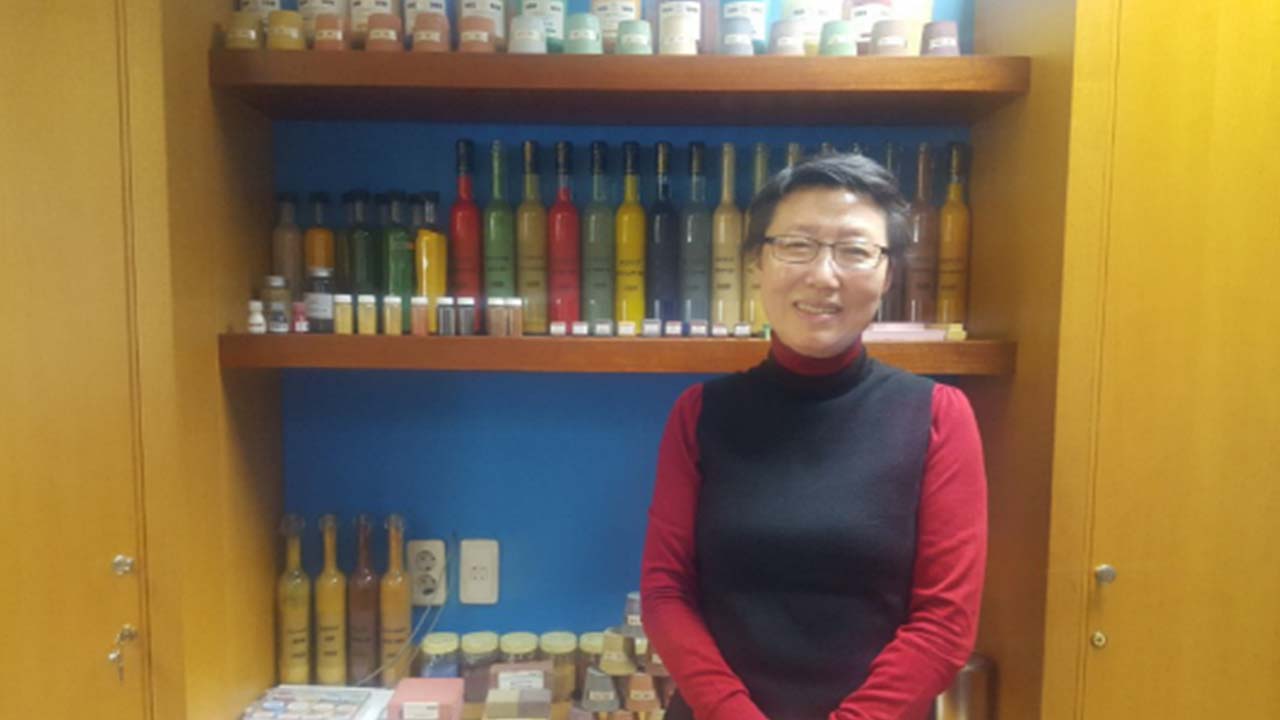
"We will absolutely deliver on our 2020 vision, '7315' — 70 billion won in sales, 30 billion won in exports, and a 15% operating margin. Business conditions keep getting tougher year after year, but we're going to compete in the global market on the strength of differentiated technology."
CEO Jang Sung-sook (62) of Wooshin Pigment laid out that "7315" vision for 2020 in an interview with the Seoul Economic Daily on the 1st. Last year the company posted 50 billion won in sales and 6 billion won in exports, putting the two-year target within reach — but Jang was cautious, noting that global competition keeps intensifying.
Wooshin Pigment produces pigment, a powdered colorant used in nearly every colored product in daily life — paints, printing, ink, artist's paint, cosmetics, and even smartphone screens. The company holds more than 40% of the domestic pigment market and supplies major facilities such as Everland and the Leeum Museum of Art, along with everyday items from plastic tableware to eyeglass frames.
Through technical cooperation with Lanxess, a subsidiary of Germany's Bayer, the company developed an eco-friendly, water-based liquid pigment, followed by a non-toxic organic-inorganic hybrid pigment — establishing itself as a leading player in the pigment market. Wooshin Pigment also holds proprietary technology for Korea's first liquid pigment usable in both water- and oil-based systems.
"Since this is a color people touch and see with their own eyes, safety and eco-friendliness matter above all else," Jang says. "We currently serve more than 500 customers at home and abroad, and the number of overseas clients keeps growing every year." Among those 500-plus customers are well-known large corporations. Building trust with major companies from the earliest days of the business has been the key to that success — landing large-scale supply contracts, where competition among small and mid-sized suppliers is fierce, by winning customers over on cost savings, quality, and thorough after-sales service.
Jang's connection to pigment traces back to her first job. Born the youngest of seven children to refugee parents, she was showered with love but, because of poverty, never got a proper education. Having to delay her middle school enrollment because of her older brother's high school start, she ended up graduating high school several years later than her peers.
In 1975, she took her first step into the workforce as a bookkeeper at a pigment specialist called Daesungsa, and worked harder than anyone. She had no idea what pigment even was when she joined, but by handling inventory from dawn to late at night, she taught herself the business and became a pigment expert. When the company faced closure in her third year there, the reckless 22-year-old decided to buy it. Living with her older sister at the time, she talked her sister into lending her 6 million won — her brother-in-law's severance pay.
A house on the outskirts of Mapo cost 2 million won back then, so 6 million won was a sum an ordinary person could barely dream of. People close to her warned her the company would fold within six months, but no one could shake her resolve. The road ahead was anything but smooth.
In the pigment industry, survival meant landing supply contracts — a reckless proposition for a young woman with no sales experience. Visiting company representatives to pitch business often led straight to "let's grab a drink." So she aimed even higher, at large corporations, reasoning that gender discrimination would be less of an issue there and she'd be spared the drinking culture.
Her first customer was Saehan Media. She wore down the company's resistance through sheer persistence, and its representative, moved by her drive, offered her a contract to supply the color for monitor cases. Starting with Saehan Media, she added customers one by one — but importing and reselling finished product from overseas had clear limits.
She asked Lanxess, a leading global pigment specialist, to transfer its technology, and after years of pursuit, the company agreed to supply semi-finished product that Wooshin could combine with its own technology to build finished products. Lanxess exports only 20 to 30 varieties of finished pigment, but Wooshin Pigment now turns that same raw material into more than 200 finished products.
With more than 20% of all employees working in the technology R&D center, Wooshin Pigment has been able to replace imports and, according to Jang, develop VOC-free organic-inorganic colorants that outperform products from multinationals like Clariant and BASF. "As we got closer to pigment production technology step by step, we eventually reached the point where we could make pigment entirely with our own technology," Jang recalls. "Once we could make finished product ourselves, we cut our selling price by more than 30% and gained real price competitiveness."
This year, Jang plans to push harder into Southeast Asia. "Sales in markets like Indonesia and Thailand are growing," she says. "We'll open a local office in Vietnam in the first half of this year and move more aggressively into global markets." Competition is intensifying not just from traditional strongholds in Europe, the U.S., and Japan, but also from low-cost Chinese products — yet Jang is confident that the trust built around Wooshin Pigment's eco-friendly pigments gives the company a real shot.
Have questions about our products?
Reach out to our team to learn more about Wooshin Pigment's pigment and colorant solutions.
Get in Touch